


This is the fifth in a series on using AI for personal health.
Full Disclosure: I built HealthScout, an app to help patients navigate our complex healthcare system.
When I asked my orthopedic specialist about a new knee treatment called Arthrosamid, he hadn’t heard of it. A month earlier, neither had I.
I have knee osteoarthritis. So, I’d done the research, knew the options, and chose a regenerative medicine specialist for PRP (platelet-rich plasma) injections because that seemed like the next logical step. Most people have never heard of PRP, but I’m a proactive patient and had researched it along with stem cell therapy.
That’s where my research ended.
I Had No Idea What I Did Not Know
At least a million new research articles are added to PubMed every year. Your doctor keeps up as best they can by reading the literature and attending conferences, but no physician can track every development across every condition affecting every patient in their practice.
Generic AI doesn’t have that constraint. It can process every article ever published. What it can’t do is connect any of them to you, because it has no idea about your health history. Ask it about your knee pain, and it will give you a thorough answer, but only to what you asked.
It won’t tell you about a treatment you’ve never heard of.
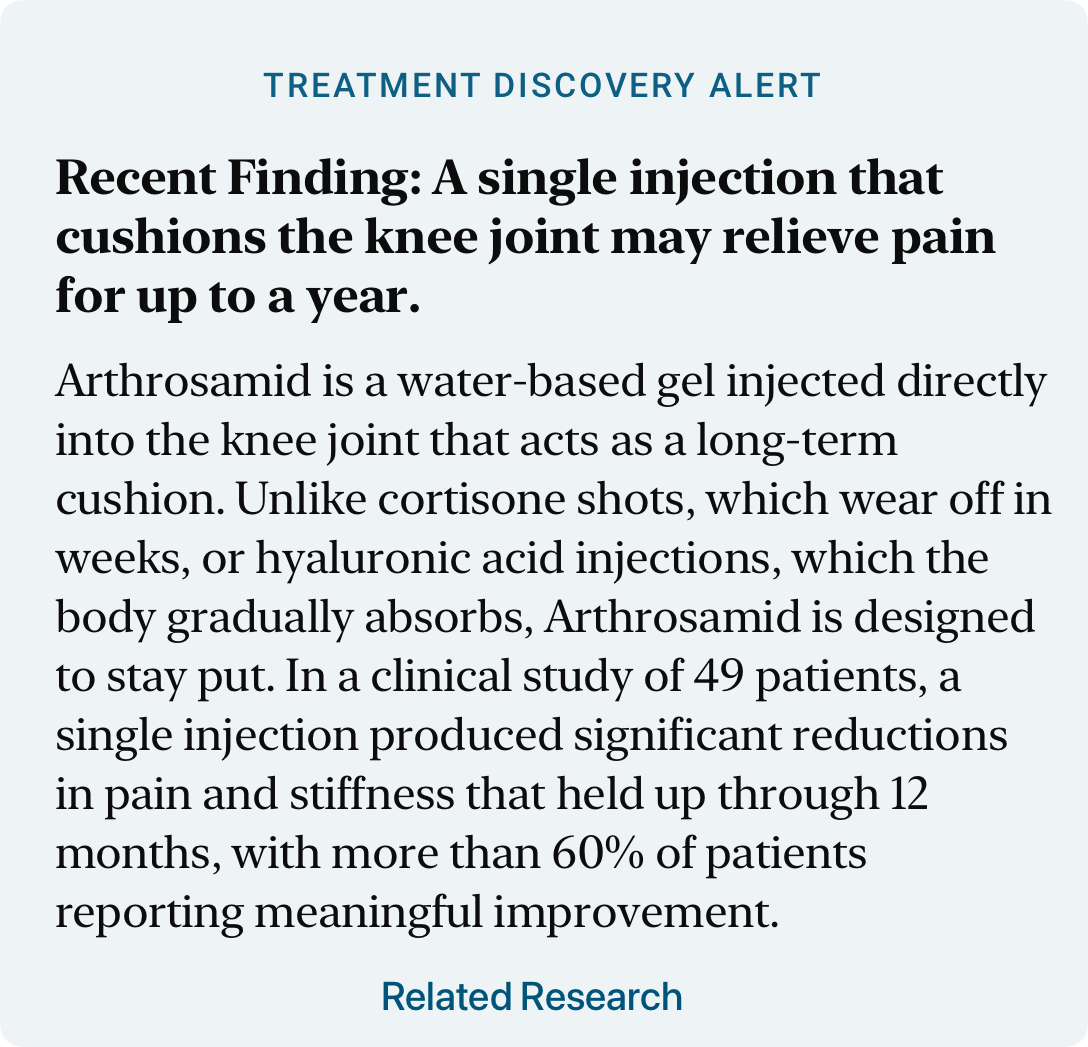
HealthScout works differently. Because it read my health records, it knew about my knee osteoarthritis without me typing a word. Every few days, HealthScout sent a new “Treatment Discovery Alert” with a research finding matched to my condition. The first few covered PRP and stem cell therapies, which gave me confidence the system was pulling relevant material.
Then it started finding things I had never heard of: genicular nerve radiofrequency ablation, low-intensity pulsed ultrasound (LIPUS), and Arthrosamid injections. Each of these is an evidence-based treatment being used clinically, but none had surfaced in my own research because I hadn’t known to look for them.
I brought HealthScout’s “Treatment Discovery Alert” knee treatment list to my orthopedic specialist. Some he dismissed, “I wouldn’t do that.” But when we got to Arthrosamid, he paused. He found the idea interesting enough to look into. Arthrosamid is only approved in Europe and Canada, so an American specialist having never heard of it makes sense. I’m still deciding whether to pursue it, but I wouldn’t have known it existed without HealthScout.
The same problem plays out in every appointment.
Doctors consistently report that patients who come in prepared have better appointments. A patient who asks “My A1C went from 5.1 to 5.6 in three years. Is it OK as long as I don’t get into the pre-diabetes range?” gets a different conversation than one who asks “is everything okay?”
The Questions You Didn’t Know to Ask
Most people don’t know what questions to ask. They get their lab results back, see everything marked normal, and assume nothing needs discussing. But lab numbers tell a story across time, across multiple tests, in the context of medications and conditions, and that story isn’t visible without something to connect the dots.
HealthScout’s Smart Question Cards do that work. Before you type anything, HealthScout analyzes your complete health picture and generates questions drawn directly from your records: your labs, your trends, your medications, your conditions.
One HealthScout user’s vitamin D came back at a “normal” 27 ng/mL. But HealthScout noticed it was at the low end of the range and generated a Smart Question Card: “Could my Vitamin D level of 27 ng/mL be affecting my energy?” She’d been feeling tired for months and hadn’t connected it to anything. She brought the question to her doctor, who agreed with the assessment and started her on supplements. Her energy came back. She wouldn’t have known to ask about vitamin D without HealthScout.
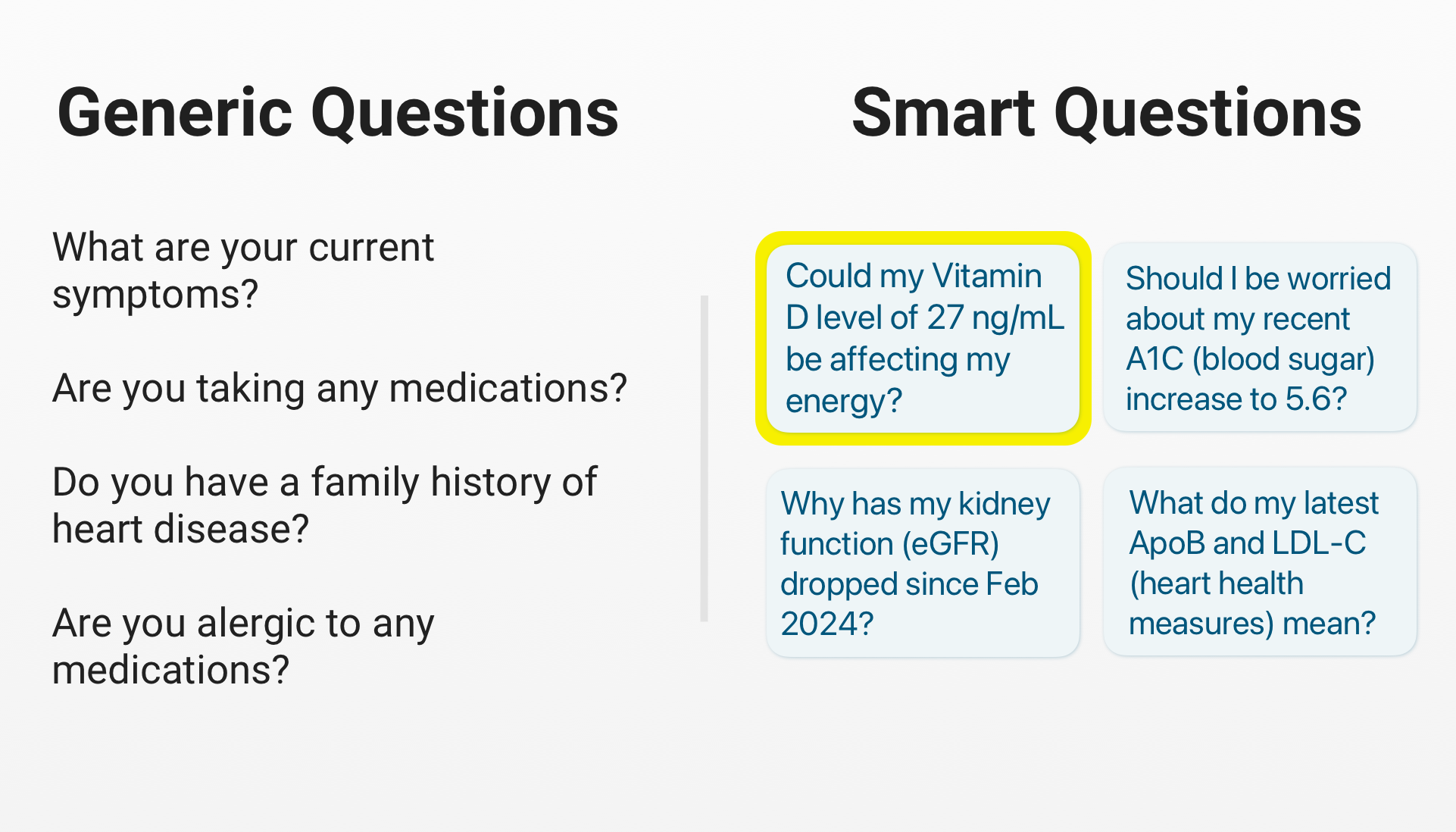
Generic AI waits for you to ask the right question. HealthScout surfaces what you should be asking based on your health records, whether or not you knew to look.
HealthScout is available now on the App Store. No email required, no account. Connect your providers or upload one record and see what your health data surfaces.
Say it isn’t so, Joe. What about the errors? Are there none? How much testing have you done?
I’m being deluged with ChatGPT “appreciations” of my memoir “Men as Friends” offering to help me promote it as Italian Literary History because of its subtitle alone “From Cicero to Svevo to Cataldo”. Beyond the pictures of the first two whose work inspired me, I don’t mention them at all.
Likewise as a career social scientist, health researcher and widower who lost his wife to decades of cancer and multiple clinical trials I’m aware of all the limits of human and digital inference. Blind faith is sometimes blind.