


Every time I write things like “Family history is one of the strongest predictors of conditions like heart disease, cancer, and Alzheimer’s,” my editor (Claude) tells me I should say “many cancers.” It makes sense that not all cancers have the same health history factor, so I haven’t questioned it and added “many.” But I wondered if there was data showing which forms of cancer have the highest family health history multiplier. Turns out there is.
A group of European researchers used the largest family database in the world to uncover just what I was looking for. The database comes from Sweden, which tracked more than 2 million confirmed cases between 1958 and 2016. For each of 31 cancers, researchers compared adults whose parents or siblings had the same cancer with adults whose relatives didn’t to determine a multiplier for each form of cancer.
I expected common cancers like breast, colon and prostate to be high on the list, but they didn’t even make the top 101. Surprisingly, three of the top five (bone, testicular, and Hodgkin lymphoma) commonly affect younger people.
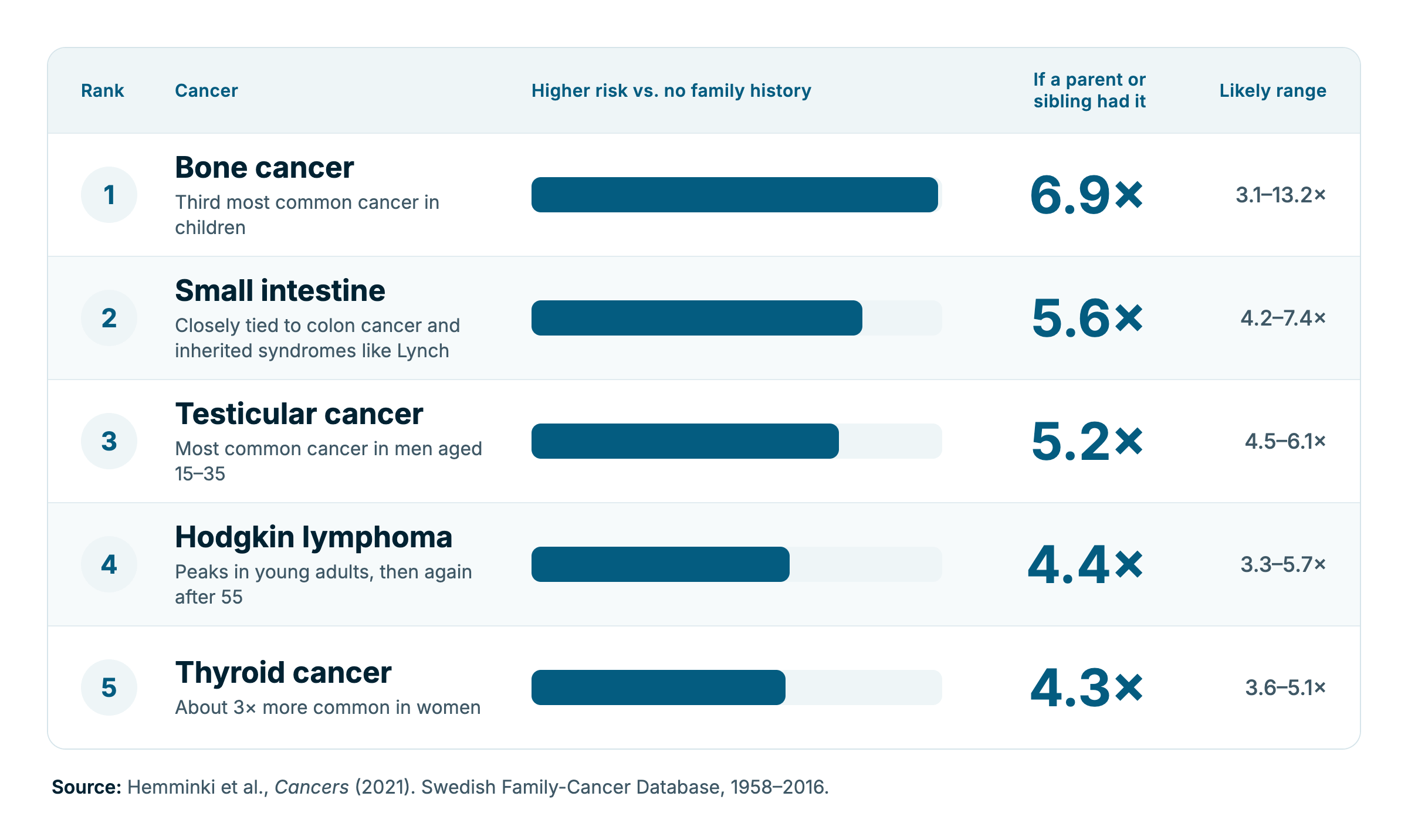
Because these three cancers affect children and young adults, family health history matters most to your kids and grandkids. None of these early-onset cancers has a screening test, even for people at high risk. But young people who know they have a family history of bone cancer or Hodgkin lymphoma can alert their doctors. With this knowledge, their doctors can take persistent bone pain or swollen lymph nodes more seriously than they would for someone without family history.
For people with family history of testicular cancer, doctors often recommend a monthly self-exam. When caught early, it can often be treated with surgery alone, without chemotherapy. Of course, none of that happens unless someone wrote the diagnosis down.
So this Thanksgiving, when the people who know about family history are there, take a few minutes and ask. Write it down on paper or use HealthScout’s Family Health History feature (free for you and everyone you add) to make it easier and shareable.
Download HealthScout in time to create your family’s profile before Thanksgiving.
Breast, colon, and prostate cancer don’t make the top 10 in terms of risk multiplier, but they’re incredibly common. For all three, a parent or sibling diagnosis can mean someone should start screening earlier, which could save a life.
Thank you Joe. At 88, with children circling 60 and no grandchildren, this won’t help me or them at all. But for the diseases you cite, it’s profoundly valuable for grandparents, parents of young children and for their older siblings. Good job!