


“This is a photo of a boy and his father in the outback,” says Chris Hemsworth, welling up as he shows the photo to the camera. “And the dad’s looking at his son with a lot of love.”
The boy in the photo is a three or four year-old Hemsworth and the dad is his father Craig, who today has early stages of Alzheimer’s.

Chris Hemsworth: A Road Trip to Remember documents how father and son explore their past and strengthen their relationship in hopes that these brain stimulating activities slow the decay of Craig’s memory.
Later in the documentary we find out Chris Hemsworth himself carries the two APOE4 genes, which increase his risk of getting Alzheimer’s by 8 to 10 times as compared to the general population.
Do You Know Enough Alzheimer’s Family History?
Chris found out he had the APOE4 genes in an unconventional way. He had a comprehensive work up as part of his health-focused National Geographic series Limitless with Chris Hemsworth in 2022. When he found out on camera, his doctor called it a “blessing” because most people wouldn’t take a genetic test until they already had symptoms in their 50s or 60s. But because Chris knew at 39, his doctor contended that “if we take every step possible, we can reduce your risk to that of anyone else.”
Chris lucked into this genetic testing because he’s a celebrity superhero doing a TV show. But you can do something simpler and more meaningful: pull together your comprehensive family history of Alzheimer’s disease. If it’s clean and you have no symptoms, you're in the best position you can be in. If you do have a family history, perhaps a genetic test would be the next step.
If you think you know your complete Alzheimer’s family history, it’s trickier than it sounds.
Extended Family Makes a Significant Difference
The fact that Alzheimer’s runs in families is not new news. Chris’s grandfather also had the disease. However, what is only starting to be understood is that more distant relatives with the disease can make a dramatic difference in the risk factor.
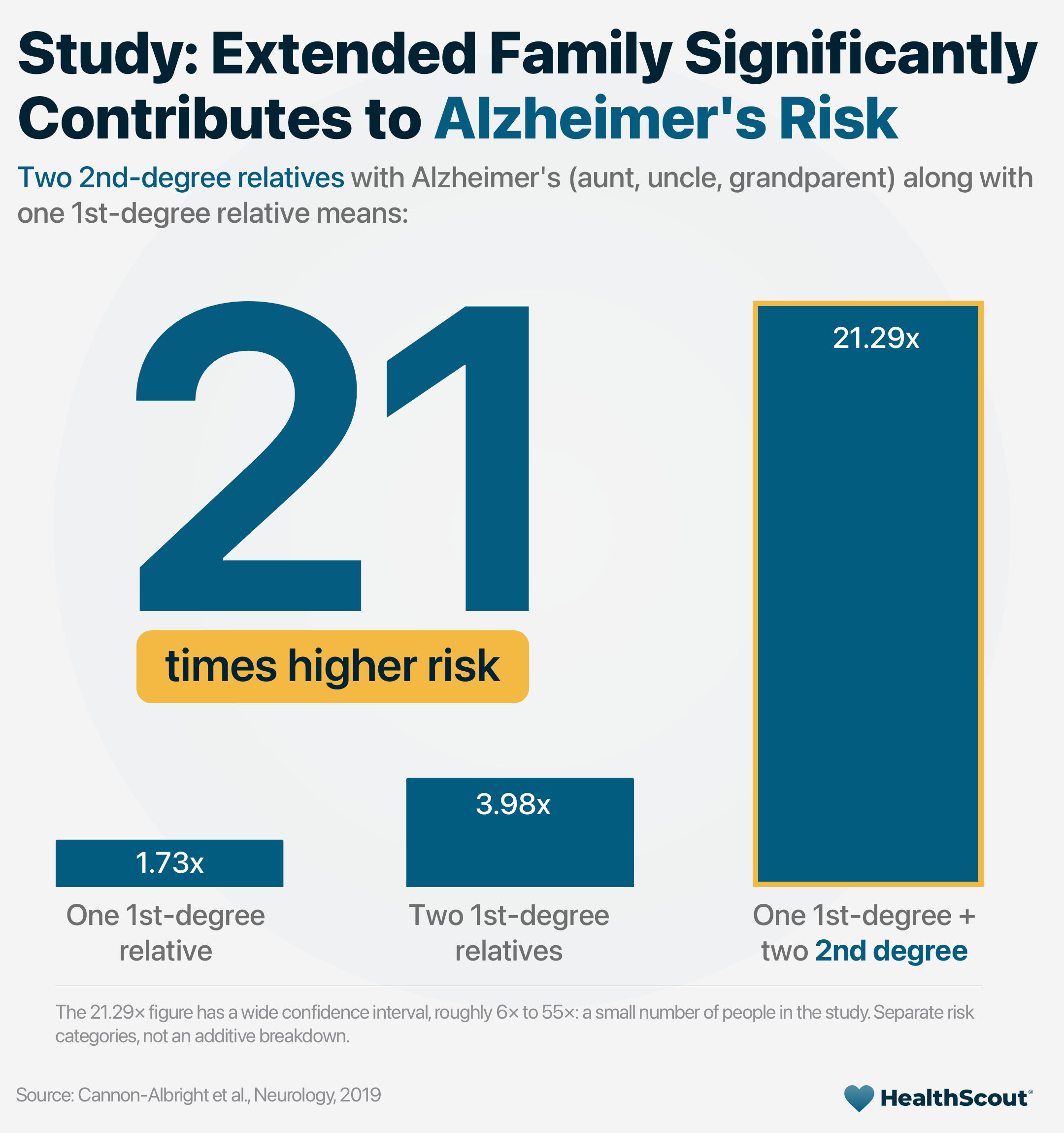
A 2019 study published in the journal Neurology used the Utah Population Database to find approximately 1.3 million individuals with at least 12 of their 14 immediate ancestors also in the data. Using death certificate analysis, they found that having one 1st-degree relative (parent, sibling, or child) plus two 2nd-degree relatives (aunts, uncles, grandparents) with Alzheimer’s in your family history increases your risk by over 21 times as compared to the general population. This family history was far more risky than having two 1st-degree relatives with the disease.
Of course, many know if their parent, sibling, or child had the disease, but do you know if your mother’s sister did? Or your grandparent who died 20 years ago? I didn’t. My grandmother died when I was in my 20s and did have some kind of dementia, but I had no idea what kind. My father’s brother was also demented later in life, but I didn’t know the details. Using HealthScout, my cousins and I collaborated to conclude that neither was diagnosed with Alzheimer’s. One remembered that my grandma’s dementia was likely vascular dementia because it started after a stroke. The other lived through his father’s diagnosis. That information can now be passed on to my children.
Find Out Now So You Can Take Action
I am publishing this article on World Alzheimer’s Day to support the global effort to raise awareness around Alzheimer’s. Until relatively recently people with a predisposition to Alzheimer’s had few options to delay or prevent the onset. Raising awareness is even more important now because some real options for high-risk Alzheimer’s patients are coming to light:
Intensive multi-domain lifestyle intervention (diet, exercise, cognitive training, social engagement) has proven to improve symptoms in a Preventive Medicine Research Institute study. The social engagement part was the primary purpose of Chris Hemsworth: A Roadtrip to Remember.
Using GLP-1 inhibitors to reduce the risk of Alzheimer’s onset. In a 2024 study, the GLP-1 semaglutide was associated with a 40–70% reduced risk of first-time Alzheimer’s diagnosis in over 1 million type 2 diabetes patients across a 3-year nationwide real-world analysis.
Anti-amyloid medicines are beginning to change what is possible in early Alzheimer disease and are expanding the opportunity to act earlier. This Nature Reviews Neurology Perspective concludes that these advances make pharmacological prevention of Alzheimer disease a feasible goal that could substantially delay or even prevent cognitive decline.
Of course, each of these options depends on knowing your risk early. That's why I built family health history into HealthScout. So your entire family’s health history is gathered in one place and saved for the next generation.
HealthScout is an educational tool only and does not provide medical advice, diagnosis, or treatment. Always consult with qualified healthcare professionals for medical decisions.
HealthScout, including the Family Health History feature, is available now on the App Store. Using Family Health History is free for you and everyone you add.