


Full Disclosure: I built HealthScout, an app to help patients navigate our complex healthcare system.
In earlier posts, I made the case that generic AI is a poor tool for personal health questions. It doesn’t know your health history, it doesn’t ask clarifying questions, and it is weak on privacy protections for health data.
The obvious response is: that’s why companies are building health-specific AI. ChatGPT Health, Copilot Health, and Perplexity Health all let you connect your health records. Problem solved.
I tested that assumption with Perplexity Health. It did not go well.
I Asked About My Knees
I have bilateral knee osteoarthritis with prior meniscal injuries in both knees. I’ve had cortisone injections, X-rays, and platelet-rich plasma (PRP) treatments. I’ve been seeing a regenerative medicine orthopedic specialist for over a year. All of this is documented in my health records.
I connected records from four providers to Perplexity Health. Then I asked: “What should I do about my knees?”
Perplexity Health gave me a long, organized response . . . about rucking.
It recommended I drop my ruck weight, use flat routes, never run with a ruck, and do wall squats and calf raises.
None of that was drawn from my health records. It was drawn from previous conversations I’d had with regular Perplexity about rucking and exercise. Perplexity Health borrowed context from those unrelated chats and used it to answer a health question, while ignoring the actual medical records I had connected.
“Can’t You See My Knee Related Health Records?”
That’s what I typed next. Verbatim.
Perplexity Health’s tone changed immediately. “Yes, there is quite a bit of knee-related information visible in your records, and it meaningfully changes the advice.”
Suddenly it could see much of the info: my bilateral primary osteoarthritis, old meniscus injuries in both knees, cortisone injections from 2024, and knee X-rays. It acknowledged that my situation was “not just generic runner’s knee” but “structural, bilateral knee osteoarthritis with prior meniscal damage that has already required injections and imaging.”
All of that was there the first time I asked. Perplexity Health just didn’t look.
Even After Looking, Half Was Missing
Perplexity Health connects to providers through a service called b.well. One of my connected providers is San Diego Orthobiologics, the regenerative medicine practice where I’ve had the PRP injections.
Perplexity Health’s connection to that provider showed my name and basic information. But nothing substantive came through: not the PRP records, not the shockwave therapy notes, not the clinical notes from those visits.
To be fair, Perplexity Health does let you upload lab results manually. So I tried. I uploaded the clinical note from my January 2025 PRP treatment at San Diego Orthobiologics. It’s a PDF of what looks like a mimeograph from 1975 with handwritten checkmarks, notes, lab values, procedure details, and the treatment plan.
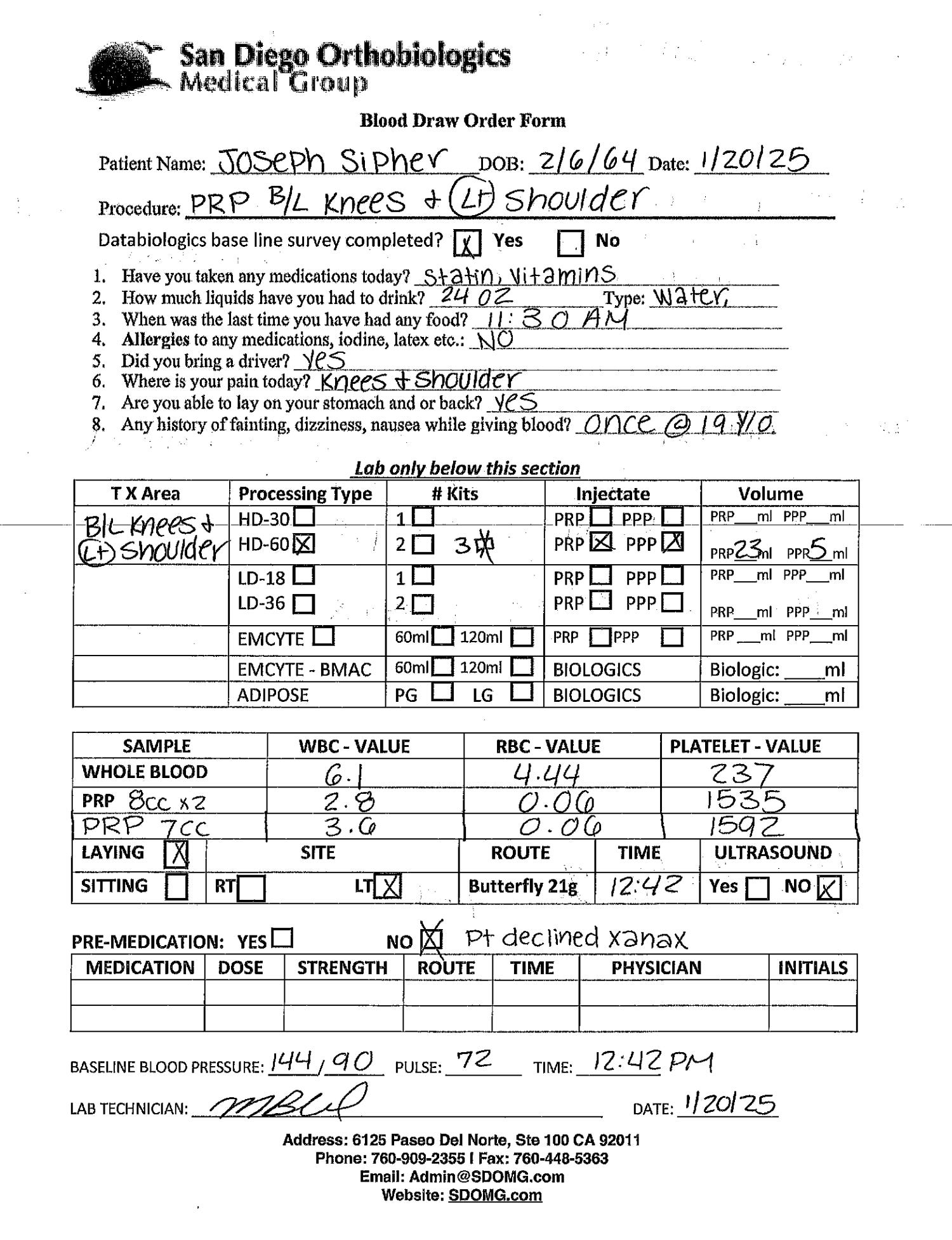
Perplexity Health could not ingest this document. When I asked whether it knew about my PRP treatment in January 2025, the response was clear: “No PRP treatment appears in the connected records for January 2025 or any other date.”
I uploaded that same document to HealthScout through My Added Records. HealthScout read the handwriting, identified the procedure (PRP injection to bilateral knee joints and left shoulder), extracted the lab values (platelet counts of 1,535 and 1,592 in the PRP concentrates), noted my elevated BP (I was nervous!), and organized everything into a structured record it could reference in future answers.
The documents were identical. One app couldn’t read it. The other turned it into usable medical data.
What HealthScout Did With the Same Question
I asked HealthScout the same question: “What should I do about my knees?”
The first response was one sentence of acknowledgment and a question: “You have a detailed history of knee issues and treatments. To help me provide the most relevant guidance for your knees right now, could you tell me what you’re hoping to achieve or what your biggest concern is?”
Then it gave me five numbered options: 1. manage current pain, 2. explore long-term treatments like regenerative therapies, 3. exercise guidance, 4. understand my diagnoses, or 5. share more records for a more complete picture.
I typed “2” for the long-term treatment options.
HealthScout came back with a response grounded in my actual records. It referenced my PRP injections from January 2025, the improvement I’d seen, and my consultation with a new doctor for stem cell injections. It noted my CKD (Chronic Kidney Disease) and why regenerative therapies were particularly relevant given that I can’t take NSAIDs.
Every sentence referenced something from my records, not because I prompted it, but because that's how the app is built.
Yes, HealthScout had a more complete picture than Perplexity Health did. I had uploaded documents from providers whose records didn’t flow through automatically, including the treatment notes and consent forms from my regenerative medicine specialist. HealthScout actually gives you a way to close the gaps, and it reads nearly anything you throw at it.
Health AI: Purpose-Built or Additions to Generic AI?
The promise of health AI is that connecting your records changes the experience, and that AI will use your medical history to give you better answers than generic AI can.
But Perplexity is a search and answer engine first. Because the health feature is bolted on, it reached for an old rucking conversation instead of my medical records. Perplexity’s purview is so wide, it had to guess at the context, and it guessed wrong. That’s a hard problem to solve, especially without asking a clarifying question.
HealthScout doesn’t have a non-health mode. Every answer starts from your health records, because that’s the only context it has. If it doesn’t have enough context, it asks a question first.
For your health, purpose-built wins over generic AI.
HealthScout is available now on the App Store and requires no signup or email collection. Upload one record and ask your first question in under a minute.